
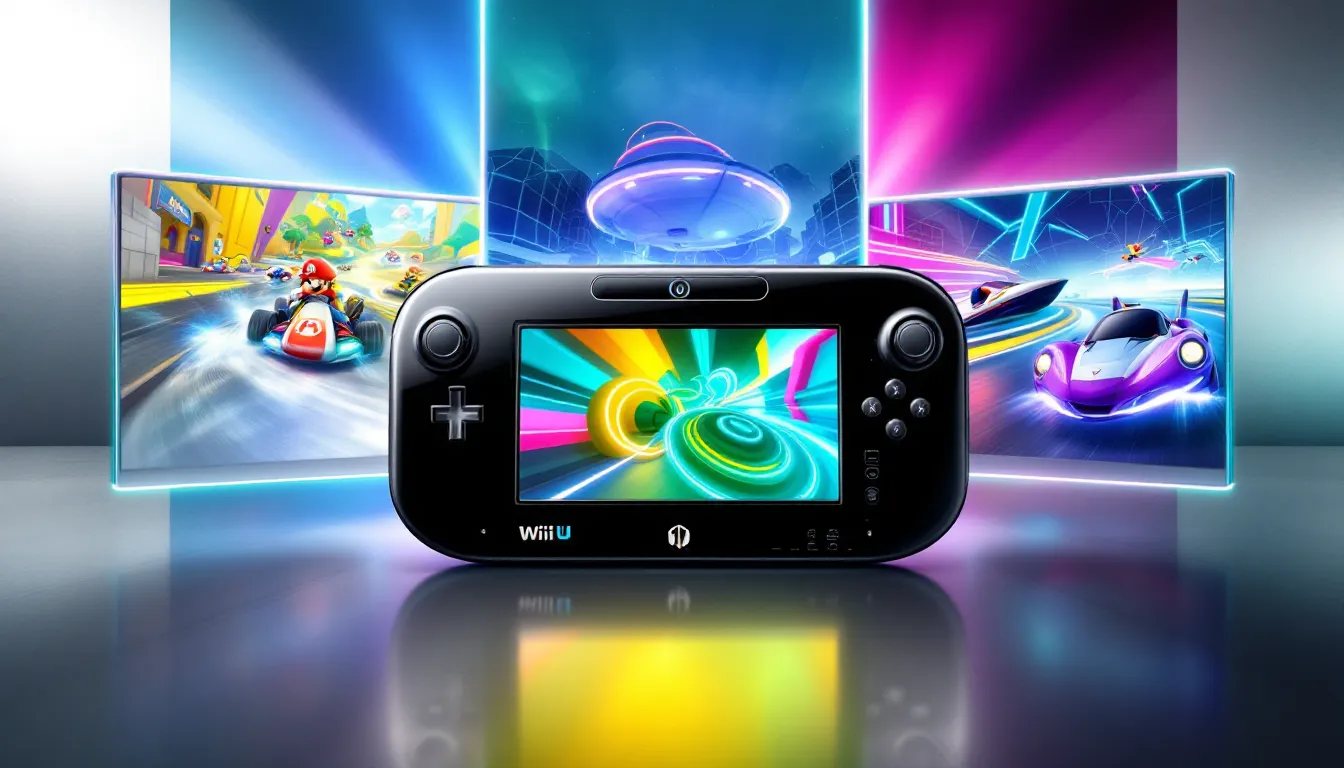
The Wii U might be Nintendo’s most divisive console, but its racing library deserves far more respect than it typically gets. When the GamePad was announced, skeptics weren’t sure how its unique touchscreen would enhance racing games. Then Mario Kart 8 proved them wrong, and the floodgates opened for a surprisingly diverse collection of Wii U racing games. Years after the console’s discontinuation, these titles remain solid ways to experience arcade racing, competitive multiplayer, and nostalgic fun, whether you’re dusting off original hardware or exploring emulation options. This guide walks through the standout Wii U racing games that still hold up, why they mattered then, and why they’re worth revisiting now.
Key Takeaways
- Wii U racing games like Mario Kart 8, Fast Racing Neo, and Sonic & All-Stars Racing Transformed remain compelling experiences that hold up well years after the console’s discontinuation.
- Mario Kart 8 revolutionized the franchise with anti-gravity mechanics and smart GamePad implementation, becoming the Wii U’s best-selling game and later the best-selling Mario Kart title on Switch.
- Fast Racing Neo proved that skill-based, F-Zero-style arcade racing could thrive on Wii U, running at impressive 1080p/60fps and delivering competitive depth outside Mario Kart’s shadow.
- Wii U racing games offered tight-knit online communities with stable netcode, no battle passes, and finished products—a refreshing alternative to today’s service-based, monetized racing games.
- You can legally play Wii U racing games today through original hardware (used consoles at $120–200 with physical copies at $20–60) or through emulation like CEMU, though emulation exists in a grey legal area.
- Beyond the main trio, Wii U’s racing library includes underrated indie titles and niche experiences that showcase the console’s unexpected depth for racing enthusiasts willing to explore.
Why Wii U Racing Games Still Matter Today
The Wii U’s lifecycle was short and turbulent, but its racing catalog carved out a real identity. Unlike the Switch, which would later dominate casual gaming, the Wii U offered something different: a middle ground between family-friendly arcade racing and deeper competitive experiences. The GamePad opened experimental design possibilities. Some games embraced it fully, others treated it as optional, and a few ignored it entirely, but the resulting variety was genuinely interesting.
Beyond hardware quirks, Wii U racing games delivered solid netcode, creative tracks, and satisfying mechanics. The console’s installed base was small, but that meant online communities remained tight-knit and toxicity stayed low compared to modern matchmaking. For solo players, the single-player campaigns and cup structures gave you actual progression to chase, not just seasonal battle passes. That structure is honestly refreshing to revisit.
Today, preservation matters. The Wii U digital store shut down in January 2023, making physical copies the only legal way to own most of these games. That scarcity has pushed interest from collectors and enthusiasts, and it’s reminded the community just how solid some of these titles actually are. The best Wii U racing games deserve their place in gaming history, not as novelties, but as legitimate entries in their respective franchises.
Mario Kart 8: The Flagship Racer
Mario Kart 8 is the obvious choice, but it earned that position. Released in May 2014, it was one of the console’s launch windows’ strongest titles and became the Wii U’s best-selling game overall. Even now, it stands as one of the strongest entries in the Mario Kart franchise, a statement backed by its track design, mechanics, and staying power.
Gameplay and Features
Mario Kart 8 introduced anti-gravity segments that fundamentally changed how you approached courses. Walls became roads. Ceilings became viable paths. That mechanic sounds gimmicky, but it worked: it opened track design in ways the series hadn’t explored before. Coupled with the return of underwater driving from Mario Kart 7, tracks felt genuinely layered in three dimensions.
The roster feels full without being bloated: 30 characters including DLC. The kart customization system lets you dial in handling, speed, and acceleration to match your playstyle, a feature that added competitive depth. Battle Mode was completely overhauled, making it an actual draw compared to previous iterations. Item balance felt tighter than before, and the removal of blue shell despair (it could only be held in third place) made comeback mechanics less frustrating.
The Game Pad implementation was smart but optional. You could use it for maps or ignore it entirely, the game never felt like it was forcing the technology on you. That restraint made MK8 more timeless than other Wii U titles that leaned too hard into gimmicks.
Why It Remains the Best
Mario Kart 8 was so good that Nintendo ported it to Switch with added DLC and called it Mario Kart 8 Deluxe. That port became the best-selling Mario Kart game of all time. But the Wii U original still holds up. Track design is sharper than MK7, mechanics are deeper than Mario Kart 64, and it’s more balanced than Mario Kart: Double Dash, which is saying something.
Live events ended years ago, but the single-player content is robust. 150cc and Mirror cup challenges provide real difficulty spikes, and unlocking everything keeps you engaged. Online rankings, while no longer active, give context to what competitive players valued. The game hits that rare sweet spot: casual enough that anyone can enjoy it, deep enough that skill expression matters.
Fast Racing Neo: The Hidden Gem
While Mario Kart 8 dominated the spotlight, Fast Racing Neo quietly carved out its own niche. Released in November 2015, it’s a Nintendo eShop exclusive developed by Shin’en Multimedia, a studio known for pushing hardware to its limits. This is a pure, arcade-style racing game that owes far more to F-Zero than Mario Kart, and that’s exactly why it matters.
Fast Racing Neo is genuinely fast. Your ship hovers just above the track at breakneck speeds, and the default 200cc speed class feels relentless. The game’s energy system is the hook: collect colored energy pads that match your current vehicle energy (blue or pink) to maintain boost momentum. Grab the wrong color and your shields drop, one more hit and you’re out. That risk-reward system creates moment-to-moment tension that’s absent from Mario Kart’s relatively forgiving racing.
The track design is exceptional. Winding circuits through neon-soaked environments, gravity-defying loops, and multiple racing lines reward precision. The roster is small, just 16 racers with minimal personality, but the gameplay is razor-sharp. Split-screen multiplayer works smoothly, and offline tournaments give you meaningful goals. The game ran at 1080p/60fps on Wii U, which was technically impressive for a racing game at that resolution.
Why it matters: Fast Racing Neo proved that the Wii U could deliver competitive, skill-based racing outside Mario Kart’s shadow. It’s the closest thing to a modern F-Zero experience you can play on Nintendo hardware (aside from F-Zero GX emulation). Online servers shut down years ago, but local play remains untouched. If you’re hunting for Wii U racing games that demand actual technique and offer genuine challenge, this is it. Many racing enthusiasts still prefer it to Mario Kart 8 for pure racing satisfaction.
Sonic & All-Stars Racing Transformed
Sonic & All-Stars Racing Transformed arrived in 2012 as a multiplatform launch title. It was Sega’s answer to Mario Kart, not by copying the formula, but by building something distinct around Sega’s character roster. The Wii U version, released in November 2012, benefited from that multiplatform legacy while offering exclusive features that took advantage of the GamePad.
Game Mechanics and Appeal
The transformation mechanic is the centerpiece. Mid-race, you and your opponents suddenly shift into boats, planes, or continue as cars depending on track sections. That constant shift in handling and perspective keeps races unpredictable. It’s not just cosmetic, your racing line changes, drift mechanics adjust, and rhythm completely resets. Some players found it chaotic: racing purists appreciated the variety.
The character roster pulls from across Sega’s catalog: Sonic, obviously, but also Aiai from Super Monkey Ball, Gilius from Golden Axe, and Vyse from Skies of Arcadia. That diversity feels genuine, not license-grabbed. The voice acting is charming, and the personality shines through even though the low-budget presentation. Drift mechanics are tighter than Mario Kart’s, rewarding long sustained drifts with bigger boost payoffs.
On Wii U, the GamePad became a second display showing upcoming track hazards and item pickups. That tangible information advantage for the player holding the pad shifted local multiplayer dynamics in interesting ways. Passing the controller added a social element that felt natural, unlike games that bolted GamePad features on as afterthoughts.
Comparison to Other Sonic Racing Titles
Sonic Team Racer (2019) arrived later on Switch and PS4, stripping away transformations and leaning into pure Sonic IP instead of Sega’s full catalog. It’s cleaner mechanically, but loses the character variety that made Transformed special. Sonic All-Stars Racing (original, 2010) was rougher mechanically and suffered from imbalance issues.
Transformed hit the sweet spot between innovation and accessibility. It’s not as polished as Mario Kart 8, and it never found Mario Kart’s cultural footprint, but it’s arguably the best purely racing-focused kart racer on Wii U. The skill ceiling is higher, drift physics reward mastery, and the character interactions feel lived-in rather than corporate. If you’re looking for something that scratches the same itch as Mario Kart but plays distinctly different, this is the answer.
Wii U Racing Games for Competitive Play
The Wii U’s online infrastructure was never robust, but its racing games maintained stable netcode. Several titles built legitimate competitive communities, even if they remained niche compared to mainstream fighting games or shooters.
Multiplayer and Online Features
Mario Kart 8’s online matched players by regional servers and VR (Versus Rating), creating tiered matchmaking. The global rankings let you see leaderboards for every track and vehicle combination. At the competitive level, players optimized kart builds around specific tracks, treating each race as a puzzle to solve. Drift timing, item conservation, and racing lines became high-skill expression vectors.
Fast Racing Neo’s online was similarly structured, though the player base was smaller. That meant faster matchmaking and less anonymous toxicity, you’d recognize regular players in lobbies. The competitive scene was tight: skilled racers posted lap times that became community targets. Shin’en maintained stable servers until shutdown, and the game still holds up in local tournaments.
Sonic & All-Stars Racing Transformed’s online wasn’t as deep. Matchmaking existed, but ranking systems were less transparent. The transformation mechanic added RNG-like elements that made consistent competitive play harder than pure racing games. That didn’t stop dedicated communities from organizing events, but the competitive ceiling was lower.
Best Racing Games for Local Co-Op
Here’s where Wii U really shined. The console’s default controller setup made local multiplayer the default, not an afterthought.
Mario Kart 8 supports up to 4 players in 150cc or 200cc modes. 200cc is where the skill expression emerges, drifts require precision, and one mistake compounds into a wipe-out. Local tournaments can get genuinely heated. The Cup structure gives you progressive challenges, and performance unlocks new characters and paint jobs.
Fast Racing Neo runs flawlessly in split-screen at 1080p/60fps, which is legitimately impressive. Two-player is smooth: four-player splits the screen into quarters but maintains performance. The arcade racing demands moment-to-moment attention, making couch gaming feel less relaxed and more competitive. It’s the best choice if you want racing that demands active skill rather than luck-based item outcomes.
Sonic & All-Stars Racing Transformed handles up to 4 local players with similar performance to Mario Kart. The transformation mechanic forces skill adaptation, mastering car drifting doesn’t translate perfectly to plane controls. That learning curve makes tournaments more interesting across skill disparities: a better car racer isn’t automatically a better plane racer.
For pure local multiplayer racing, Mario Kart 8 is the safest choice. For competitive skill-based play, Fast Racing Neo. For chaos and variety, Sonic & All-Stars Racing Transformed.
Underrated Wii U Racing Games Worth Playing
Beyond the obvious trio, the Wii U library holds hidden racing gems that deserve rediscovery. These aren’t mainstream titles, but they offer genuine value for racing enthusiasts exploring the catalog.
Indie Racing Games on Wii U
The eShop cultivated a surprising collection of smaller racing projects. Shin’en’s output extended beyond Fast Racing Neo, games like Nano Assault Neo-X weren’t pure racers, but Affordable Space Adventures dabbled in racing-adjacent physics. More directly, FAST Racing League was an earlier, prototype-like racer that prefigured Fast Racing Neo’s energy system.
Splatoon’s influence was felt across Wii U racing too. Games trying to capture local multiplayer magic often looked to Splatoon’s design philosophy. That meant shorter tracks, tighter handling, and mechanics that didn’t punish newcomers but rewarded mastery. Several eShop racers followed that template with varying success.
The indie racing space on Wii U never reached Switch’s saturation, but titles like Curve Digital’s racing ports and experimental physics games carved out their niches. Discovery on the eShop was harder than modern stores, no algorithms, just browsing, which is partly why these games stayed obscure. Reviewers across platforms like GameSpot and DualShockers occasionally covered eShop surprises, but consistent coverage was spotty.
Retro-Inspired and Niche Racing Experiences
Nintendo’s own retro-inspired titles deserve mention. F-Zero GX wasn’t a Wii U release, but it was playable via backwards compatibility emulation, and enthusiasts often discuss it in context of what Wii U racing could’ve been if Nintendo had greenlit a new F-Zero. The absence of a new F-Zero made Fast Racing Neo feel even more important as a substitute.
Excitebike received a spiritual successor in Excitebike: World Rally (3DS exclusive), but Wii U’s lack of an updated Excitebike experience left a gap. Some fans created ROM hacks and mods to fill that void, highlighting how the community valued variety in racing sub-genres.
Moreniche titles like LEGO racing games arrived on Wii U, offering simplified, co-op focused experiences targeting younger players. These weren’t mechanically sophisticated, but they served a purpose for family gaming. That stratification, hardcore racers like Fast Racing Neo at the top, family-friendly LEGO games at the bottom, Mario Kart 8 straddling the middle, gave the Wii U racing library unexpected depth.
Worth noting: coverage from outlets like IGN often glossed over these niche titles, focusing instead on the major releases. That coverage gap meant these games stayed hidden unless you actively dug through the eShop or read dedicated racing communities.
How to Find and Play Wii U Racing Games Today
The Wii U is officially dead. Nintendo shut down the eShop in January 2023, meaning new purchases are impossible. But playing these games in 2026 is still viable through multiple avenues.
Emulation and Preservation
CEMU, the Wii U emulator, runs Mario Kart 8, Fast Racing Neo, and Sonic & All-Stars Racing Transformed at higher resolutions and frame rates than original hardware. Many versions run at 4K/60fps or higher, with enhanced graphics through shader mods. Controller compatibility is solid, you can use modern controllers with full rumble support.
Emulation requires dumping game files from original cartridges using a modded Wii U console or Citra for certain titles. That’s technically a grey area legally, even if you own the physical game. CEMU exists in a similar preservation space as other emulators, developers argue it serves archival purposes, but publishers view it as piracy enablement. The reality is more nuanced, but the legal status remains murky in most jurisdictions.
Original Hardware remains the legal safest option. Used Wii U consoles cost $120-200, and physical game copies range from $20-50 depending on condition and demand. Mario Kart 8 holds value at $40-60 because it’s still highly sought. Fast Racing Neo, being eShop-only, is harder to acquire, but some players kept digital licenses intact, and transfers remain possible through account migration on remaining Wii U consoles.
The second-hand market is active. eBay, local classifieds, and dedicated retro gaming stores stock Wii U inventory. Supply is finite and shrinking, each year, more consoles fail or get lost to storage. Prices have stabilized at reasonable levels since the console discontinued years ago, unlike N64 or GameCube prices which continue climbing.
Backwards Compatibility: Neither PS5, Xbox Series X, nor Switch offers Wii U backwards compatibility. The Switch can play remastered versions of Mario Kart 8, but that’s a separate, updated game. If you specifically want the Wii U versions with their original mechanics and GamePad integration, original hardware or emulation are your only paths.
For players committed to preservation, the Wii U racing library remains accessible. It requires more effort than booting up Game Pass, but that friction is becoming part of the appeal for retro enthusiasts.
Conclusion
The Wii U’s legacy is complicated, but its racing library deserves respect. Mario Kart 8 proved that the GamePad could enhance gameplay without dictating it. Fast Racing Neo showed that skill-based arcade racing could thrive outside mainstream franchises. Sonic & All-Stars Racing Transformed delivered personality and mechanical variety that made it stand apart from its competitors.
These games mattered because they took risks. They didn’t just iterate on established formulas, they added transformations, anti-gravity segments, and energy-based boost systems that gave players new things to master. The online communities were tighter, the mechanics more transparent, and the play-to-win ratio non-existent.
In 2026, that matters more than ever. Modern racing games are increasingly service-based, seasonal, and monetized. Wii U racing games are finished products: you buy them, you own them, and they don’t change. That’s become a feature, not a limitation. For anyone tired of battle passes and cosmetic shops, Wii U racing offers a simpler, more satisfying alternative.
Whether you’re revisiting original hardware, emulating on PC, or just curious about what you missed, the Wii U’s racing catalog repays exploration. Start with Mario Kart 8 if you want polished accessibility. Choose Fast Racing Neo if you want pure skill-based racing. Pick Sonic & All-Stars Racing Transformed if you want personality and variety. Each represents something genuine in racing game design, and each still stands on its own merits.